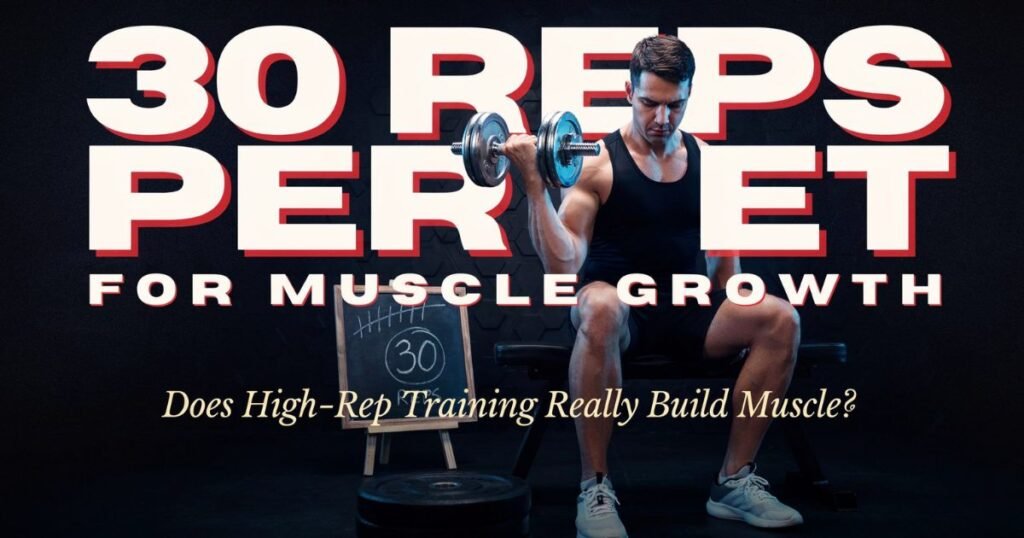
30 rep rule for muscle growth has become a popular topic because many people wonder if lighter weights and higher repetitions can build muscle as effectively as heavy lifting. Research suggests that high reps can support muscle growth when you train close to failure and continue using progressive overload over time. Still, the number of repetitions is only one part of successful training. Your workout quality, recovery, nutrition, and consistency all play a major role.
Whether you train at home or in the gym, understanding how the 30 rep rule for muscle growth works can help you improve results, avoid common mistakes, and choose the best strategy for your fitness goals.
1. What Does 30 Reps Per Set Mean in Strength Training?
Understanding the 30 Reps Per Set Training Method
The phrase 30 Reps Per Set simply means performing thirty continuous repetitions before ending a set. Instead of choosing a heavy load that limits you to eight or ten repetitions, you select a Light Weight that allows many more movements. This style of Resistance Training has become increasingly popular because newer research shows muscle size doesn’t depend only on heavy lifting. Instead, muscles respond to hard work that pushes them near their limit. That’s why many lifters now experiment with high repetitions while chasing Muscle Growth.
Although this approach looks easy from the outside, those final repetitions become surprisingly demanding. As fatigue builds, every repetition requires greater effort. If the weight is challenging enough, the last few repetitions recruit more muscle fibers. Those demanding repetitions create the stimulus needed for adaptation. The overall objective remains identical to traditional Strength Training. You challenge the muscle enough that it must repair itself stronger during recovery.
2. Can 30 Reps Per Set Build Muscle?
Does High-Rep Training Really Stimulate Muscle Growth?
The short answer is yes. Can You Build Muscle With 30 Reps Per Set has become one of the most researched questions in modern fitness. Current evidence suggests you absolutely can. The key isn’t simply reaching thirty repetitions. Instead, you must reach those repetitions while training very close to Muscular Failure. When the muscle can barely complete another quality repetition, the body receives a strong signal to increase Muscular Hypertrophy.
Scientists now believe that only the final challenging repetitions create the strongest muscle-building stimulus. These are commonly called Effective Reps. Early repetitions mostly prepare the muscle, while the last few repetitions force the body to adapt. Whether those effective repetitions occur after eight repetitions or after twenty-eight repetitions matters less than most people once believed. This explains why properly performed High Reps can still produce impressive Muscle Gains.
3. What Science Says About High-Rep Training
Research Comparing High Reps and Low Reps
Modern exercise science has changed many traditional beliefs about bodybuilding. Several studies comparing High Reps vs Low Reps found similar improvements in Muscle Growth when participants trained close to failure. Researchers commonly compare heavier loads with lighter loads representing approximately 30% of One-Rep Max. Surprisingly, both groups often build comparable amounts of muscle despite using very different weights.
That doesn’t mean every repetition range produces identical results in every situation. Heavy loads remain superior for maximizing Strength Gains because they train the nervous system differently. However, when the goal focuses purely on muscle size, lighter weights performed with sufficient effort can create a surprisingly similar Muscle Building Response. This discovery has expanded training options for beginners, older adults, home exercisers, and people recovering from injuries.
Scientific Comparison of Rep Ranges
| Training Style | Typical Rep Range | Primary Goal | Muscle Growth Potential |
|---|---|---|---|
| Heavy Weight Training | 1–5 reps | Maximum strength | High |
| Traditional Hypertrophy | 6-12 Rep Range | Muscle size | Very High |
| Moderate Reps | 12 Reps Per Set | Size and endurance | High |
| High Repetition Training | 20 Reps Per Set to 30 Reps Per Set | Endurance and hypertrophy | High when trained near failure |
4. Is the Traditional Hypertrophy Rep Range Still Better?
Why the Traditional Hypertrophy Rep Range Remains Popular
Although research supports 30 Reps Per Set, the classic Hypertrophy Rep Range continues to dominate serious bodybuilding programs. Most experienced coaches recommend the 5-10 Rep Range or the well-known 6-12 Rep Range because it provides an excellent balance between muscle stimulation and manageable fatigue. You can train with enough resistance to challenge your muscles without spending excessive time completing each set. That makes your Workout Performance more efficient over an entire training session.
Another reason this range remains effective is that it delivers more Effective Reps with less unnecessary effort. Instead of performing twenty-five easier repetitions before reaching the challenging part of the set, you reach those productive repetitions much sooner. This improves your Stimulus-to-Fatigue Ratio, allowing you to complete more quality sets while keeping overall fatigue under control. For most people focused on Muscle Building, this remains the smartest long-term strategy.
High Reps vs Traditional Hypertrophy
| Training Style | Main Benefit | Biggest Limitation |
|---|---|---|
| 5-10 Rep Range | Excellent balance of size and strength | Slightly higher joint loading |
| 6-12 Rep Range | Best overall Muscle Growth | Requires moderate to heavy weights |
| 30 Reps Per Set | Useful with limited equipment | Creates more Workout Fatigue and longer sets |
5. 30 Reps vs Heavy Weights: Which Builds More Muscle?

Comparing Light Weight and Heavy Weight Training
One of the biggest debates in fitness is 30 Reps vs Heavy Weights. Both methods can increase Muscle Growth if you train hard enough. However, each approach stresses the body differently. Using Heavy Weight recruits more muscle fibers immediately because your muscles must overcome greater resistance. With Light Weight, those same fibers gradually become involved as fatigue builds during later repetitions.
Heavy lifting also improves Strength Gains much faster because your nervous system learns to produce more force. In contrast, high-repetition training develops greater Muscle Endurance while still supporting muscle size when performed correctly. Neither method is automatically better. Your choice should depend on your equipment, training experience, recovery ability, and overall Fitness Goals.
Which Training Style Fits Your Goal?
| Goal | Best Training Method |
|---|---|
| Build maximum strength | Heavy Weight training |
| Increase muscle size | Combination of 6-12 Rep Range and occasional 30 Reps Per Set |
| Improve endurance | High Reps |
| Home workouts with limited equipment | 30 Reps Per Set using bodyweight or light resistance |
| Joint-friendly training | Moderate weights with controlled repetitions |
6. The 30 Rep Rule for Bodyweight Exercises
Why Bodyweight Training Works Well With Higher Repetitions
The 30 Rep Rule has become especially useful for people training at home. Since bodyweight exercises don’t always allow you to increase resistance easily, increasing repetitions becomes an effective way to continue challenging your muscles. Push-ups, lunges, squats, dips, and inverted rows often respond well to higher repetition ranges before adding more advanced exercise variations.
Bodyweight training also encourages better Exercise Form because lighter resistance allows you to focus on controlled movement. Instead of rushing through repetitions, you can slow the lowering phase and maintain constant muscle tension. This increases Muscle Activation while helping reduce Injury Risk. Eventually, once thirty repetitions become comfortable, progressing to harder exercise variations usually provides better results than endlessly adding more repetitions.
Best Bodyweight Exercises for High Repetitions
| Exercise | Beginner Target | Advanced Progression |
|---|---|---|
| Push-Ups | 20–30 reps | Decline or weighted push-ups |
| Bodyweight Squats | 30 reps | Bulgarian split squats |
| Walking Lunges | 20 each leg | Jump lunges |
| Glute Bridges | 30 reps | Single-leg bridges |
| Chair Dips | 20–30 reps | Parallel bar dips |
7. Progressive Overload: The Real Secret to Muscle Growth
Why Progressive Overload Matters More Than Rep Count
Many people focus only on 30 Reps Per Set, but the real driver of Muscle Growth is Progressive Overload. Your muscles adapt quickly to repeated challenges. If every workout stays exactly the same, your body has little reason to grow. Progressive overload simply means making your workouts slightly harder over time by increasing weight, repetitions, sets, or training quality.
You don’t need to make huge changes every week. Small improvements work best. For example, you might perform one extra repetition, improve your Proper Form, reduce rest time, or use a slightly heavier weight. These gradual changes keep your muscles adapting while supporting long-term Muscle Adaptation without overwhelming your recovery.
Simple Ways to Apply Progressive Overload
| Method | Example |
|---|---|
| Increase weight | Lift 5 pounds more than last week |
| Add repetitions | Perform 12 reps instead of 10 |
| Increase sets | Complete four sets instead of three |
| Improve technique | Use cleaner Exercise Form |
| Slow the tempo | Control each repetition for longer muscle tension |
8. Common Mistakes When Training With 30 Reps
Mistakes That Limit Your Muscle Growth
One of the biggest mistakes is stopping too early. Many people finish a 30 Reps Per Set workout while they still have plenty of energy left. If you never approach Training Close to Failure, the muscles receive only a weak growth signal. High-repetition training works only when those final repetitions become genuinely difficult.
Another common mistake is sacrificing Proper Form just to complete more repetitions. Poor technique reduces Muscle Activation and increases Joint Stress. Instead of rushing through each repetition, focus on slow, controlled movement. Quality always beats quantity when your goal is long-term Muscle Building.
Mistakes vs Better Choices
| Common Mistake | Better Approach |
|---|---|
| Stopping far from failure | Train within Reps in Reserve of failure |
| Using poor technique | Maintain Proper Form every rep |
| Ignoring recovery | Allow muscles time to recover |
| Chasing only Muscle Burn | Focus on consistent progress |
| Using the same workout forever | Apply Progressive Overload regularly |
9. Who Should Use 30 Reps Per Set?
Who Benefits Most From High-Rep Training
30 Reps Per Set works especially well for beginners, home exercisers, older adults, and anyone with limited equipment. Since lighter resistance places less stress on joints, high-repetition workouts can be a practical option during rehabilitation or when heavy lifting isn’t possible. People using resistance bands or bodyweight exercises also benefit because adding repetitions is often easier than increasing weight.
Experienced lifters can also use this method strategically. High-repetition sets fit well after heavy compound lifts or during deload weeks. However, competitive bodybuilders and strength athletes usually rely more on the traditional Hypertrophy Rep Range because it improves Workout Efficiency while producing excellent Muscle Gains over time.
Who Should Be Careful With High Repetitions
| Training Level | Recommendation |
|---|---|
| Beginners | Excellent starting option |
| Home gym users | Very effective |
| Older adults | Joint-friendly when supervised |
| Bodybuilders | Best used as an accessory method |
| Powerlifters | Focus mainly on heavier loads for Strength Gains |
10. Best Training Tips to Maximize Muscle Growth
Train Smarter Instead of Just Training Harder
If your goal is 30 Reps Per Set for Muscle Growth, remember that consistency beats perfection. Every workout should have a purpose. Focus on Progressive Overload, maintain Proper Form, and stay close to Muscular Failure without sacrificing technique. A balanced approach produces better long-term results than constantly chasing heavier weights or more repetitions.
Recovery deserves the same attention as training. Muscles don’t grow while you exercise. They grow afterward when your body repairs damaged muscle fibers. Eat enough protein, sleep seven to nine hours each night, and avoid excessive Workout Fatigue. Combining smart programming with proper recovery creates the best environment for Muscle Building.
Simple Tips for Better Results
| Tip | Why It Helps |
|---|---|
| Warm up before lifting | Reduces Injury Risk |
| Focus on Proper Form | Improves Muscle Activation |
| Train consistently | Supports long-term Muscle Growth |
| Sleep 7–9 hours | Improves recovery |
| Eat enough protein | Supports muscle repair |
| Track your workouts | Makes Progressive Overload easier |
| Rest between sessions | Prevents excessive fatigue |
Conclusion
30 Reps Per Set for Muscle Growth isn’t a myth. Research shows that high-repetition training can increase muscle size when you train close to Muscular Failure and consistently apply Progressive Overload. However, this doesn’t mean every workout should follow this style. Most lifters still achieve excellent results using the traditional Hypertrophy Rep Range, especially between five and twelve repetitions.
The smartest approach is flexibility. Use 30 Reps Per Set when training with lighter weights, bodyweight exercises, or during recovery phases. Use moderate and heavier loads when your goal is maximizing strength and workout efficiency. By matching your repetition range to your Fitness Goals, maintaining Proper Form, and staying consistent, you’ll continue building muscle, improving performance, and making steady progress in every stage of your fitness journey.
FAQ’S
Can you build muscle with 30 reps?
Yes. You can build muscle with 30 reps if you train close to muscular failure and gradually increase the challenge over time.
What is the 3-3-3 rule gym?
The 3-3-3 rule usually means performing 3 exercises, 3 sets, and 3 key movement patterns for a simple, balanced workout. Its meaning can vary by program.
What kills muscle gains the most?
Poor recovery, not eating enough protein or calories, inconsistent training, and skipping progressive overload are the biggest muscle gain killers.
What age is hardest to gain muscle?
Building muscle becomes harder after about 60 years of age because muscle mass and hormone levels naturally decline, but strength training still works.
What drink builds muscle fast?
A protein shake made with whey protein and milk is one of the best drinks to support muscle growth after a workout.
2 Responses